Wingmen, Swarms, and the Race to Command Them
The US Air Force awards production contracts for 1,000 autonomous combat jets, four months ahead of schedule, and opens a six-vendor competition to write their brains. Also: 43 FPVs collapse a road bridge, a European C2 startup raises €32 million at Eurosatory, Britain puts a combat drone on a carrier, Ukraine’s relay drone extends the kill zone, a 48-hour counter-UAS robot, and drone strikes push Russia toward a fuel crisis.
America’s Thousand Wingmen
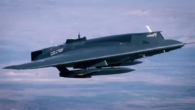
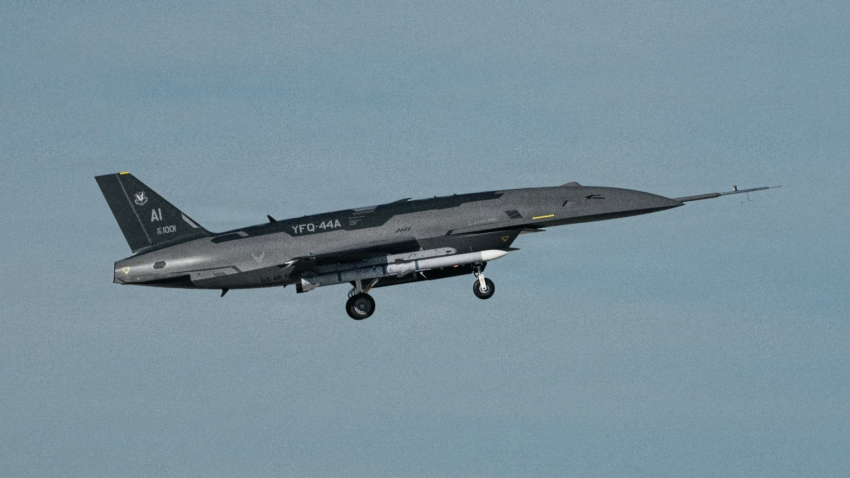
On 17 June the US Air Force awarded production contracts to General Atomics and Anduril for the first generation of Collaborative Combat Aircraft (CCAs): uncrewed jets designated FQ-42 and FQ-44, designed to fly alongside crewed fighters in contested airspace. The awards came four months ahead of schedule. The Air Force intends to field approximately 1,000 CCAs in total, with over 150 combat-capable aircraft to be procured by the end of the decade under these contracts. Separately it awarded mission autonomy software contracts to six vendors, Anduril, General Atomics, Lockheed Martin, Northrop Grumman, RTX Collins Aerospace, and Shield AI, with a primary software provider to be selected by summer 2027. The architecture deliberately decouples software from hardware so autonomy packages can be updated or swapped across platforms independently of the airframe.
Forty-Three Drones, One Bridge
Russian forces brought down a two-lane road bridge over the Nitrus river in Ukraine’s Kherson region using 43 FPV drones, each carrying a repurposed RPG warhead weighing around five pounds. A video posted to Telegram on 12 June showed the Kontora group of Russia’s Zapad unit methodically striking all five support columns. The shaped-charge warheads stripped away reinforced concrete, leaving bare steel rebar unable to carry the bridge’s own weight. The entire operation cost under $25,000 — roughly half the price of a single US precision-guided bomb, and against the backdrop of the 350 tons of conventional bombs that US research found it took on average to destroy a bridge in World War Two. David Hambling writing in Forbes notes that FPVs fitted with add-on wings can already hit targets 60 miles away, and those carried by mother ships can reach further still — which means larger bridges and potentially other large structures now sit within the target envelope of a weapon that previously looked purely tactical.
European C2 Raises €32 Million
That same software-first logic is what Paris-based Comand AI is selling to NATO ground forces. The company announced a €32 million Series A at Eurosatory on 17 June, led by Blossom Capital with a strategic investment from Saab. The funding will expand deployment of its Prevail platform, already in operational use with units in France, Germany, and Ukraine, across the wider NATO market and into air and maritime domains by the end of the year. Prevail runs as a digital command staff on a single laptop: a set of specialised AI agents covering mission analysis, course-of-action generation, and tactical situation control, capable of coordinating both crewed units and drone swarms. Saab’s investment includes an agreement to integrate Prevail into GlobalEye, its airborne early warning and control aircraft. The company’s pitch is explicit: compress the OODA loop at every echelon while keeping humans in command of what the algorithms propose.
Britain’s Carrier to Get a Wingman
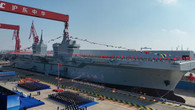
The Royal Navy has given Parliament a defined timeline for its own CCA ambitions. Minister for Defence Readiness Luke Pollard told MPs that the Navy intends to conduct an embarked demonstration of an uncrewed Collaborative Combat Aircraft from a Queen Elizabeth-class carrier within 18 months, under Project VANQUISH. The First Sea Lord had trailed the intention at DSEI in September 2025; what changed is that a minister has now committed to a date on the record. The familiar caveat applies: any actual acquisition decision remains tied to the unpublished Defence Investment Plan, the spending document that triggered two ministerial resignations a fortnight ago. The demonstration is concrete. The procurement is not yet funded.
Ukraine’s Relay Drone Extends the Kill Zone
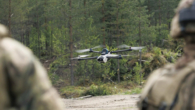
Ukrainian company Roboneers has introduced the Wardog TRN, a mid-sized quadcopter designed not to strike but to relay. Carrying a 3 kg communications payload and climbing to 900 metres, it extends the radio horizon to approximately 120 km, allowing operators to maintain control of mid-range strike drones operating deep behind Russian lines without relying on Starlink or expensive autonomous guidance. The platform uses an optical-inertial navigation system to hold position under electronic warfare jamming, and is available through Ukraine’s Brave1 Market procurement platform. The significance is multiplicative: a single Wardog TRN increases the number of strike drones a unit can field by reducing the per-drone cost of communications. Its high altitude and prominent radio-frequency signature will make it an obvious target, and the authors of the piece note Russia has every incentive to develop the same capability.
A Drone Killer in 48 Hours
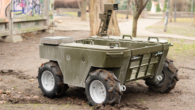
At Fort Carson, Colorado, six defence companies assembled a working autonomous counter-UAS ground vehicle in under 48 hours during the US Army’s Operation Jailbreak exercise. AZAK provided the robot chassis, Allen Control Systems added its Bullfrog autonomous machine-gun turret, Havoc supplied autonomous driving software, Leonardo DRS installed the radar, Picogrid handled integration, and Anduril’s Lattice platform provided the battle management layer. The hunter-killer pair — one vehicle sensing, one shooting — is designed to rove ahead of infantry formations and engage UAS swarms before they reach troops. Operation Jailbreak was explicitly modelled on Ukraine’s battlefield networking approach and shaped by the pressure the Iran conflict put on US forces facing cheap one-way attack drones in the Middle East. The Army has not yet ordered production.
Drones Drain Russia’s Fuel
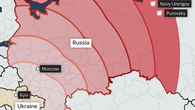
Ukraine’s long-range drone campaign against Russian oil infrastructure has shifted from volume to precision. Analysts at commodity intelligence firm Kpler told Radio Free Europe that strikes have increasingly targeted hydrocrackers and secondary processing units, equipment that takes weeks or months to replace under Western sanctions, rather than simpler crude storage. Russia’s offline secondary processing capacity in May ran 1.2 to 1.3 million barrels per day above the prior year. Diesel production fell 10 percent in both April and May. Russia banned gasoline exports on 1 April and aviation fuel exports from 1 June, with rationing reported across 14 regions. The Russian government acknowledged the impact publicly for the first time on 9 June. Analysts caution against declaring a tipping point but note the campaign is now exhausting the system’s capacity to absorb and recover rather than simply causing temporary disruption.
Image – USAF YFQ-44A