So Which Tasks Will Be Left For Humans?
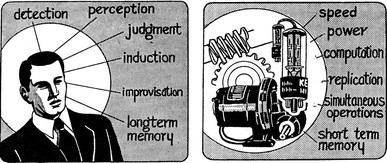
In 1951, the psychologist Paul Fitts drew a line for the US National Research Council on the division of labour between people and machines in aviation. Humans got judgement in novel situations, flexibility, inductive reasoning, the detection of faint signals, and the ability to improvise. Machines got speed, consistency, routine processing, physical power, and the ability to compute and store information long-term. It was not a prophecy, just a snapshot of the human factors knowledge of the day, and it held roughly for most of the century that followed. It is not holding now.
Writing in Wired’s first issue in January 1993, Bruce Sterling visited a US Army simulation facility at Fort Knox and described Colonel Jack Thorpe’s vision for the successor to SIMNET. Simulate before you build. Train before you deploy. Let capability emerge from the digital world before it gets stockpiled in the physical one. Sterling left with a question nobody has answered cleanly since: when training and war stop being distinguishable, what happens to the professionals and the standards built around that boundary?
Three decades on, the arc Sterling described is running in production. Since 2022 Ukraine has become the most intensive live testing environment for uncrewed systems in the history of warfare, and by early 2026 President Zelenskyy was reporting that over 80% of Russian losses were being inflicted by drones. Autonomy modules costing around $50, bolted onto first person view drones, multiplied strike success rates for inexperienced operators. Iran confirmed the pattern at a different scale. Through the Maven Smart System, AI assisted targeting pushed daily processing capacity from under 100 targets a day to 5,000. Fitts’s speed and consistency column has swallowed ground that used to belong to judgement.
Simulation itself has moved from support function to product. The US Army trained the AI for its AiTDR counter-drone system entirely inside a digital twin before any physical hardware existed. Shield AI’s acquisition of the simulation company Aechelon, in a deal valuing the combined business at $12.7 billion, points to where the industry now thinks the money sits. The US Department of War’s own AI Acceleration Strategy names a priority programme “Ender’s Foundry”after Ender’s Game, the novel in which the final training exercise turns out to be the real war. The reference is not decoration. It describes what the programme is actually for.
Fitts’s flexibility and judgement have not disappeared, but they are being pushed later in the decision chain and squeezed for time once they arrive there. The UK Ministry of Defence’s Future Operating Environments 2040 document names the mechanism directly. The further evolution from artificial general intelligence to artificial superintelligence, it notes, is feasible by 2040, and “if artificial intelligence (AI) verifiably outperforms humans, the shift from human-in-the-loop to human-on-the-loop will extend onward to human-starting-the-loop. In some circumstances it may even reach a position of human-out-of-the-loop.” Researchers studying AI enabled targeting have a term for what happens to the operators left in that chain: cognitive offloading, where the sense of responsibility fades because the analytical work was already finished by the time a human saw it.
The bottleneck is not only cognitive. At Fort Irwin in 2025, a US Army unit detected 399 targets during a training rotation and could not engage a meaningful fraction of them. The fires apparatus and the available human attention could not keep pace with what the sensors were feeding in. Fitts warned in 1951 that both men and machines break down under overload. Seventy five years later, and with drones he never anticipated, that warning still holds up.
None of this means machines stop annexing tasks that used to belong to humans. They will keep doing that. The open question is who gets to decide where the new line falls, and how publicly that decision gets made. Right now it is mostly being set by engineers writing training environments for autonomous systems, choices that function as rules of engagement without the doctrine, certification or accountability that would normally come attached to that label.
Fitts asked what each side of the human and machine partnership was good at. Those categories still exist in 2026, but the border between them is moving faster than the institutions built to govern it, and faster than most of the public debate has caught up with. Which tasks stay with humans is one question. Who is authorised to keep moving that boundary is the harder one, and it is still mostly unanswered.
Image – Illustrations of the Fitts list taken from the original 1951 report ‘Human engineering for an effective air-navigation and traffic-control system.’
Source – de Winter, J.C.F., Dodou, D. Why the Fitts list has persisted throughout the history of function allocation. Cogn Tech Work 16, 1–11 (2014). https://doi.org/10.1007/s10111-011-0188-1 (open access)