Shaheds That Think, Drones That Pay, and a $4 Billion IPO
Ukraine’s top drone analyst says AI autonomous targeting is weeks away for Shaheds. Also: Kyiv’s e-Points system is steering units toward harder targets 100 km from the front, a hand-launched recon drone reaches 150 km for a fraction of the usual cost, an Israeli loitering munitions maker heads to Nasdaq at $4 billion, and France picks an AI interceptor and plans to build it at home.
AI Getting Closer to Choosing Its Own Targets
The next generation of Russia’s Shahed loitering munitions will select and strike targets without a human authorisation in the loop. That is the assessment of Serhii “Flash” Beskrestnov, an advisor to Ukraine’s defence ministry on drone warfare, writing this week. Russian forces already possess Chinese-made cameras capable of tracking a designated target once found, he said, but the step from tracking to autonomous strike decision is still “only going through the first stages of combat testing” on both sides. Terminal guidance for the Shahed’s fixed-wing airframe is technically harder than for a quadcopter, but Beskrestnov confirmed it “has already been implemented both in our UAVs and in those of the enemy.” The implication is direct: once that capability is wired into the flight controller at production scale, electronic warfare that jams GPS or severs a radio link becomes irrelevant to the terminal phase. Combined with target recognition and autonomous strike selection, the result is a weapon that operates independently from launch to impact.
Points, Targets, Repeat
Ukraine’s e-Points incentive system is doing more than supplying drones to front-line units. It is actively reshaping which targets those units pursue. The system, which rewards soldiers for destroying equipment and uploading video confirmation, has been updated to weight points toward harder, higher-value targets more than 100 km from the front line, including rear-area logistics nodes, barracks, and trucks that were previously left alone. Kateryna Stepanenko of the Institute for the Study of War told Business Insider the updates are incentivising units across the entire front line to pursue targets that are more challenging to reach. The mechanism is also a real-time demand signal: if the general staff decides it needs a particular target class hit harder, it raises the reward weighting and units adjust within days. Over 400 combat units have now placed orders totalling more than 500,000 drones and pieces of equipment through the Brave1 Market marketplace, with more than 800 Ukrainian-made products available for redemption.
Sweetheart: 150 km, One Sixth the Price
A Ukrainian firm called General Chereshnya has developed a hand-launched fixed-wing reconnaissance drone, the Sweetheart, that weighs 4 kg, spans 1.7 m, and can fly 150 km into Russian-held territory for up to three hours. The aircraft carries a gimbaled zoom camera, a laser rangefinder, and a jamming-resistant datalink. At altitudes between 50 m and 70 m it is acoustically inaudible from the ground. But the specification is arguably less significant than the price. The founder, Yaroslav Hryshyn, says a single unit costs roughly one sixth of comparable systems, a deliberate choice. “At such a cost, the military will not be afraid to lose a unit, and in some cases will be able to consciously send it on a one-way mission in order to obtain critically important intelligence,” he told Defence Blog. When a drone costs as much as a military vehicle, commanders treat it as a precious asset and limit the risks they accept. When the cost drops to a fraction of that, the psychology changes. Serial production is expected in autumn 2026.
UVision Heads to Nasdaq at $4 Billion
Israeli loitering munitions maker UVision Air is preparing a Nasdaq initial public offering that will seek a valuation of $3.5 to $4 billion, after its founder Aaron Frenkel rejected a $2.9 billion pre-IPO offer from Israeli institutional investors as too low. The prospectus is expected in the second week of July, with a roadshow to follow across Israel, the United States, and Europe. JPMorgan is leading the offering, which aims to raise between $500 million and $1 billion. The company’s anchor asset is a five-year contract with the US Army, signed in October 2025 alongside US firm Mistral, worth up to $982 million. UVision makes the HERO family of loitering munitions, systems that can loiter, identify, and strike a target, with an abort option allowing recovery and reuse in some configurations. The IPO arrives during a defence sector correction: Elbit Systems is down roughly 20 percent since March, and NextVision has shed 28 percent over the same period. Frenkel is betting that a global investor base will assign a richer valuation than domestic institutions were prepared to offer.
France Picks AI Interceptor, Plans Local Build
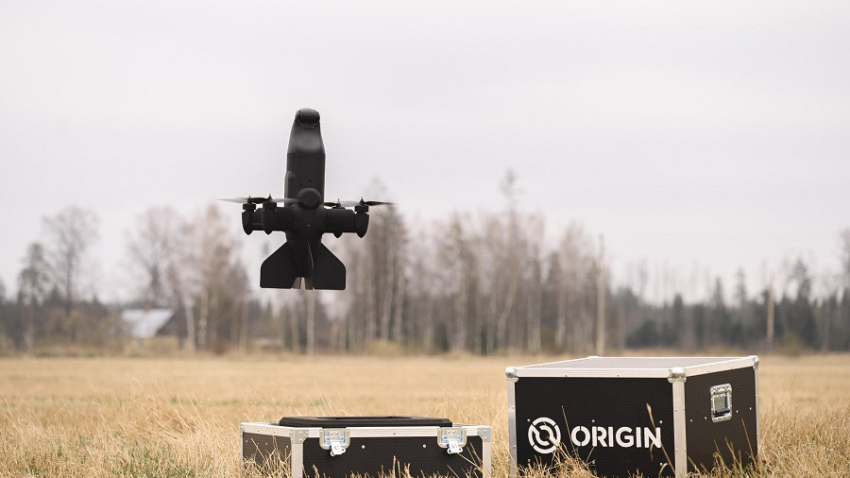
France has selected the BLAZE autonomous interceptor drone from Latvia’s Origin Robotics and its French partner DSV, following a competitive assessment of multiple counter-drone systems. First deliveries are expected within weeks. BLAZE is a man-portable system that takes radar data directly to feed an onboard autopilot, flying autonomously toward a target before the operator authorises the final intercept, through direct impact or a fragmentation warhead, with a human in the decision loop throughout. It can be deployed in under 10 minutes and already holds NATO codification, simplifying integration into alliance logistics. France becomes the fourth European operator after Latvia, Belgium, and Estonia. The procurement comes with a technology-transfer arrangement: DSV will assemble and manufacture systems domestically under a “Made in France” framework, building a sovereign counter-drone supply chain rather than simply importing hardware. The pattern is consistent across Europe this week: Lithuania separately unveiled the AI-guided Black Wasp interceptor capable of 320 km/h autonomous intercepts, while France moves simultaneously on both a kinetic counter-drone solution and, separately, the conversion of 20 A400M transports into drone and cruise missile carriers.
Image – Origin Robotics