Ukraine’s Ambush Drones Take To Transmission Lines
Ukrainian ambush drones now dangle from power lines, and nobody yet knows whether they can draw power from them. Also: a Geran that navigates by sight, Kyiv’s data opens to Britain, a kamikaze BTR-60 and a Pacific without rules.
Perched Above The Road
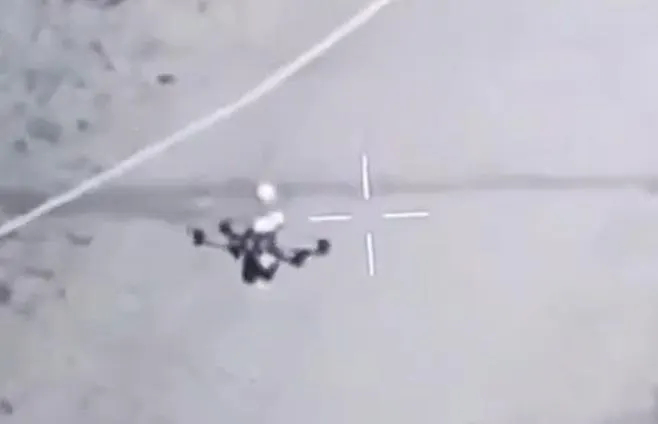
Ukraine’s ambush drones have moved up. On 26 September, drone specialist Serhii “Flash” Beskrestnov posted video of an FPV (first-person view) drone flying beneath a power line and climbing until it latches on, then hanging there waiting for a target, as David Hambling reports for Forbes. Ground-based ambushers, known as Zhdun (“Waiter”), sit on roads or rooftops with their motors off for hours. They see little, and sweeping drones find them easily. A drone on a wire sees further and is harder to spot and harder to bomb. The open question is whether it can take current from the line. Aethermachines patented exactly that in 2010, with a 40-minute recharge. If the Ukrainian version does the same, endurance is no longer the limit.
A Geran That Reads Terrain
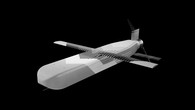
Russia is working on navigation from the other direction. Militarnyi reports a new Geran-5 variant, which a monitoring channel calls the K5. It carries an electro-optical correction system that matches camera images of the ground against stored imagery, the same principle as the Digital Scene Matching Area Correlator (DSMAC) used on Tomahawk. There is no satellite signal to jam. The baseline Geran-5 is a 6.5-metre jet with a 90-kilogram warhead, a cruising speed of 450-600 km/h and a range of about 950 kilometres. Ukrainian intelligence has not confirmed the new system, and its published parts list for the Geran-5 includes no DSMAC unit.
Five Million Frames For Britain
For the first time, Kyiv has opened its AI training infrastructure to a foreign government. Britain’s Ministry of Defence has partnered with Avengers AI Labs, which holds more than 5 million annotated battlefield frames drawn mainly from the DELTA battle-management system. They cover tanks, artillery, air defence, infantry and Shahed drones. The data is anonymised and released on a delay, and companies work inside a secure perimeter with no download access. Up to a dozen UK firms are being invited to submit proposals, with priority on systems that keep working when communications and satellite navigation fail.
Soviet Armour, Remote Control
Not every uncrewed system is new. The 3rd Separate Assault Brigade fitted a Soviet-era BTR-60PB armoured personnel carrier with remote control and operator cameras and used it as a kamikaze vehicle against Russian positions at Nove in the Lyman sector, according to Militarnyi. A reconnaissance drone followed it to correct its route. Brigade commander Andriy Biletskyi said it “blew up the enemy’s strongest fortifications.” Similar unmanned conversions of the BRDM-2, M113 and M1117 are under way. Russia tried explosive-packed MT-LBs as early as 2023.
Cheap Hulls, Costly Targets
At sea, NATO is retraining. Exercise Dynamic Guard 26-2 ended at Taranto after five days. It is the alliance’s premier exercise for electronic warfare and anti-ship missile defence, and this was the first time it included counter-drone warfare. Commodore Georgios Kypriotis, commander of Standing NATO Maritime Group Two, was blunt about small uncrewed surface vessels (USVs). “Now, with a small USV, you can accomplish a significant hit to your enemy, and this is something different,” he told UK Defence Journal. Crews practised switching their air defences from jets to drones, using both soft-kill and hard-kill methods.
A Homegrown Mavic
Ukraine is also replacing Chinese equipment at the reconnaissance end. Vyriy Industries has unveiled Slavic, a quadcopter with controls modelled on the DJI Mavic so that operators need little retraining. A 40,000 mAh solid-state battery gives up to 1.5 hours of flight and a 30-kilometre tactical range. Like the Geran, it uses optical positioning when satellite signals are denied. It has already been combat-tested with seven units.
Encounters Without Rules
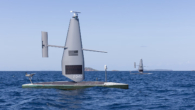
The rulebooks have not kept up. In Small Wars Journal, the authors recount how in June an autonomous boat operated by Seasats got close enough to a Chinese Type 052D destroyer to film it, 65 miles northwest of Luzon inside the Philippines’ exclusive economic zone. The 2014 Code for Unplanned Encounters at Sea (CUES) says nothing about identifying a drone’s operator, contacting a remote pilot, or what to do when a platform ignores warnings. The authors propose a supplementary code: recognisable identification, a reachable human operator, minimum separation distances and agreed warning steps before anything is jammed, captured or shot down. Without one, a warship captain facing an unknown boat has to guess what it is doing.
Featured Image – A Ukrainian FPV drone waits in ambush, suspended beneath a power line – Serhii Flash via Telegram