The Story Behind the “Drone” Word
Most every story on this site uses a word that started life describing an insect with no job. Tracing how “drone” got from a beehive to a battlefield says something about how military language actually forms: less design, more nickname that stuck.
The word is old. Around the year 1000, a scribe compiling a Latin-Old English word list wrote down the Old English word for a male bee, dran, next to the Latin word for the same thing, fucus. That single entry is the earliest written record of the word in English. A drone’s role in the hive is narrow. It does not forage, does not defend, does not make honey. It exists to mate with a queen, and it dies shortly after. By the early 1500s the word had picked up a second, figurative sense: an idler, someone doing no useful work. Around the same time, a related but separate meaning appeared, a low continuous hum, the sound associated with a bagpipe’s constant note. Both senses were in circulation for four centuries before anyone attached the word to a machine.
The aircraft link starts earlier than most people assume. In March 1917, an unmanned biplane fitted with radio guidance equipment designed by Archibald Low flew under remote control for the Royal Flying Corps, the project known as the Aerial Target. Several manufacturers, including de Havilland, built the airframes; Low built the system that steered them. It was the first successful flight of its kind. The aircraft did not carry the word “drone.” That came almost two decades later, and from a different programme entirely.
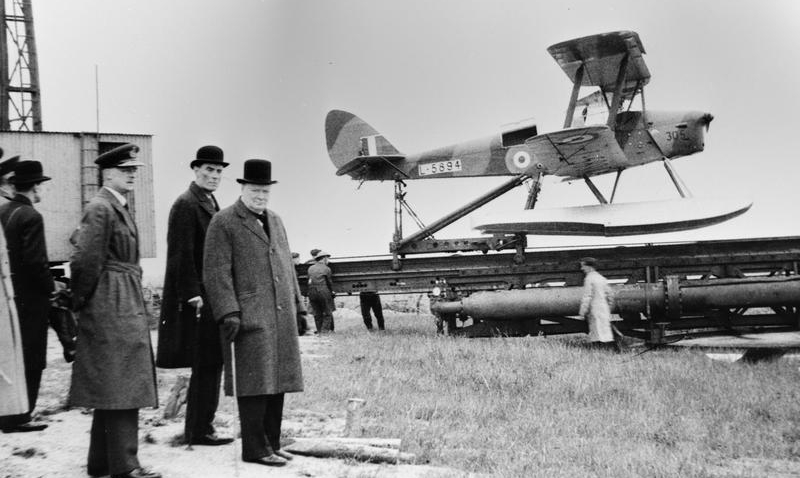
In 1935, Britain’s Royal Navy converted a de Havilland Tiger Moth into the DH.82B, nicknamed the Queen Bee, a radio-controlled target for anti-aircraft gunnery practice, built at RAF Farnborough between late 1933 and early 1935 by pairing a de Havilland Moth Major fuselage with a Tiger Moth’s engine, wings and controls, and first tested from HMS Orion. Nobody knows for certain why it ended up called Queen Bee, but two clues point the same direction. “Queen” almost certainly came from its predecessor: in 1931 the Royal Aircraft Establishment had built a radio-controlled target from a Fairey IIIF floatplane and called it the Fairey Queen. Only three were built and the first two crashed on launch, but the concept worked well enough to justify a proper successor. “Bee” is less settled. One theory holds it came from de Havilland’s own habit, Geoffrey de Havilland was an amateur entomologist who named nearly all his aircraft after flying insects, the Moth, the Tiger Moth, the Fox Moth, later the Mosquito and Dragonfly, and the target-drone variant happened to carry the model code DH.82B, an easy pun to reach for. A second theory, argued at length by the technology site Hackaday, runs the opposite way: that the aircraft flew at a constant, unvarying throttle and made a steady low hum, and gunnery crews nicknamed it for that sound, “drone” already meaning a hum, before the word ever meant an aircraft. On this account “Queen Bee” is the pun and “drone” came first, not the other way round. Neither theory has a surviving document to settle it. Between the two, the sound is probably the stronger clue: it explains why the very next thing that happened was the US Navy adopting “drone,” not “bee,” as its own term.
When US Chief of Naval Operations Admiral William Standley watched Queen Bee being used for gunnery practice off HMS Orion that year, he brought the idea home and assigned Commander Delmer Fahrney to build an American equivalent. According to the military historian Steven Zaloga, Fahrney named the American programme’s aircraft “drone,” a direct nod to the Queen Bee: a lesser aircraft, in the terminology of the hive, serving alongside her. The US Navy formally logged “drone” into its own aircraft-naming system in 1936, designated simply “TD” for target drone, and for close to two decades afterward the word meant only that: a remote-controlled aircraft built to be shot at.
World War II turned the word from a naval term of art into a wider military category. The British actor Reginald Denny, a model-aircraft hobbyist, founded the Radioplane Company, which supplied the US Army’s OQ-2 and the Navy’s TDD-1, the Target Drone Denny 1, for gunnery training at scale. By the 1950s “drone” was standard usage across the American military for any unmanned target aircraft.
It did not stay that specific for long. From the late 1950s, the word started attaching itself to almost anything unmanned, whatever the job. It got applied retroactively to the German V-1 flying bomb of the Second World War, a weapon nobody had called a drone at the time. A 1965 Martin Marietta patent used the word for an unmanned docking vehicle designed to help NASA’s Gemini spacecraft rendezvous in orbit, a system that never flew but shows how far the term had already drifted from gunnery targets. The Lockheed D-21, a Mach 3 reconnaissance aircraft built to overfly China, was called a drone in contemporary sources despite having nothing to do with target practice. In 1960 the Navy fielded the Gyrodyne QH-50, a small remote-controlled helicopter that carried a homing torpedo out to a submarine contact and released it, the first drone, in the word’s own sense at the time, built to deliver a weapon rather than absorb one.
That looseness did not last. Through the 1960s, as the military’s use of unmanned aircraft kept multiplying, more technical alternatives entered official use, unmanned aerial vehicle first appearing in a Department of Defense appropriations document in 1972, remotely piloted vehicle following in government paperwork by the late 1980s. “Drone” persisted anyway outside official channels, because it was short and it was already understood.
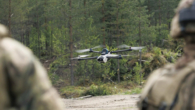
The word’s return to prominence has a fairly precise date. The CIA’s armed Predator strikes began weeks after the September 11 attacks, and on October 21, 2001, Bob Woodward’s Washington Post article “CIA Told to Do ‘Whatever Necessary’ to Kill Bin Laden” fixed “Predator drone” back into everyday usage, describing the aircraft’s Hellfire missiles by name. The word drifted a second time over the following decade, this time downward in scale, attaching itself to the small consumer quadcopters that had nothing to do with gunnery targets or Predators at all. Today it covers a FPV strike drone assembled from commercial parts in a Ukrainian workshop and a $40 camera toy with equal ease.
None of this was planned as terminology. A British target aircraft likely got its “Queen Bee” name because the manufacturer’s owner happened to be an amateur entomologist who named his aircraft after insects. Where “drone” itself came from is less settled: it may be a direct nod to Queen Bee or it may come straight from the aircraft’s steady, unvarying hum, or both at once, the two explanations reinforcing rather than replacing each other. Either way, it stuck. It was short, and it was already close enough to what it needed to mean. Ninety years later, the aircraft, and now ground and naval systems, it describes do far more than any Queen Bee ever did, but the word hasn’t kept pace with what it now describes. Even the military’s own attempt to replace it with something more serious, UAV, RPV, did not stick.
Top Image – The Prime Minister, Mr Winston Churchill, with Captain The Right Honourable David Margesson, Secretary of State for War, watching preparations being made in an unspecified UK location for the launch of a De Havilland Queen Bee seaplane L5984 from its ramp.
Imperial War Museum