China Puts Drone Engine Exports Under Licence
China now licenses exports of drone jet engines and radios like those in Russia’s Gerans, but one phrase decides what is caught. Elsewhere: FPVs topple a building, a robot launches 18 drones, Congress weighs AUTOWARCOM, laser shoot-off, Latvian sea drones.
China Tightens The Tap
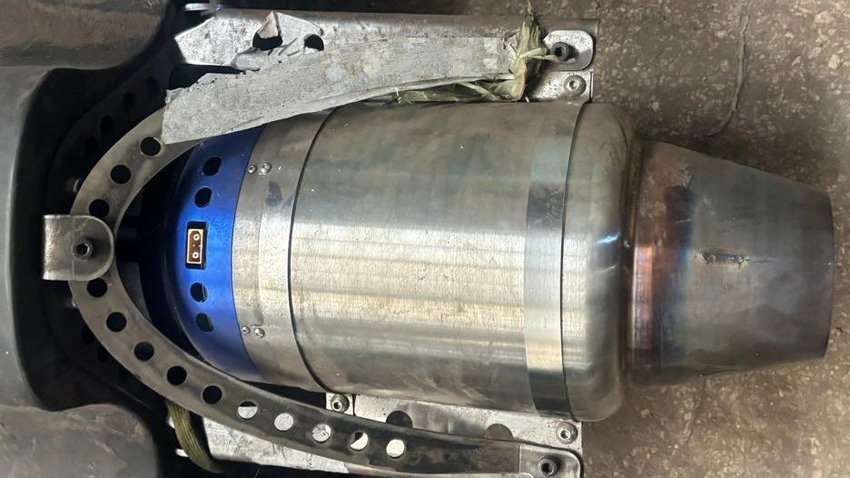
From 18 November, Chinese firms need a licence to export turbojets of 400 newtons or more built for drones, under Announcement No. 49, issued on 19 October by China’s Ministry of Commerce (MOFCOM), its customs administration and the Central Military Commission’s Equipment Development Department. Every Telefly engine that Ukraine’s Military Intelligence Directorate (HUR) has pulled from jet Gerans clears that floor, at roughly 785 to 1,960 newtons, Defence Ukraine reports. The rules also cover drone autopilots, radios reaching 30 dBm or controlling more than 10 drones, heavy brushless motors and speed controllers, and know-how including anti-jam navigation. Ukraine’s sanctions commissioner Vladyslav Vlasiuk called it a start, but navigation modules, gimbal cameras and Geran-4 servos remain outside it. The catch is a design test. MOFCOM says engines also designed for crewed aircraft or other uses are not covered, and one Telefly engine is sold for aircraft, drones and snow-clearing machines. Approval is the default and Russia is not named, unlike the strict US-specific vetting China imposed in August. Drone engines above 16 kW have needed licences since 2023, yet Chinese engines kept reaching Russia, at times declared as industrial refrigeration units.
Bringing Down The House
A new Ukrainian video shows first-person-view (FPV) drones demolishing a six-storey concrete building occupied by Russian troops, likely in the Donetsk region, writes David Hambling for Forbes. Drones fly in through a blown-out wall, turn down a second-floor corridor and land among others already waiting, perhaps a dozen in all. Then the whole stack detonates at once and the building collapses, centre first, which suggests an internal support was destroyed. A typical FPV carries a warhead of four pounds or less, so perhaps 50 pounds of explosive brought down the structure. Explosive ordnance consultant Seán Moorhouse said detonating the drones one by one would have done little, but linking the charges changes the equation, and he suspects new technology that has not been seen in public. The watermarks suggest units including the 429th Separate Unmanned Systems Regiment Achilles and the 5th Separate Assault Brigade.
A Swarm From A Box
The US Army has launched an 18-drone swarm from an uncrewed ground vehicle during a live-fire demonstration at Grafenwoehr Training Area in Germany. An R3NEGADE vehicle drove out of a standard 20-foot shipping container and fired the drones from an HIV3 swarm launcher. After a TRV-150 drone marked the target with smoke, the swarm carried out a coordinated autonomous strike. Another R3NEGADE carried a remote weapon station with a Javelin missile. The event was run by the Army’s DEVCOM Armaments Center with US Army Europe and Africa and the 7th Army Training Command, under the Remote Rapid Response Autonomous Contingency Team (R3ACT) effort. Troy Brannon, who led the demonstration, framed it around scalability, lethality, reach and autonomy for ground manoeuvre commanders. A TRV-400 with the developmental FIR3FLY anti-armour capability was on static display. The report does not say what human approval the strike required.
Congress Weighs A Drone Command
A Congressional Research Service (CRS) briefing for lawmakers sets out the choices facing Congress over the Pentagon’s planned Autonomous Warfare Command (AUTOWARCOM). Defense Secretary Pete Hegseth wants the four-star command by 1 October 2027 with service-like authorities, including its own manpower, budget, acquisition powers and career paths, but his memo does not say which laws need changing. The Senate Armed Services Committee’s version of the 2027 defence bill would instead allow a Robotic and Autonomous Systems Command (RASCOM), with test and evaluation authority and contracting capped at $20 million per contract. The House version has no such provision. Committee chair Senator Roger Wicker backs RASCOM to standardise how the services use drones in combat, while a retired Air Force lieutenant general warns of a bureaucracy built around technology rather than faster use in combat. CRS notes that Congress may question whether it has enough information to judge either proposal.
A Laser Shoot-Off
Seven high-energy laser weapons will face off against drone targets at Dugway Proving Ground in Utah in mid-December, Business Insider reports. The field includes Allen Control Systems’ BULLFROG, Aurelius Systems’ ARCHIMEDES, AeroVironment’s LOCUST X1, Kord Technologies’ FIREFLY, Lockheed Martin’s Crossbow, Thor Dynamics’ LASER ARMOR and Yrikka’s drone-mounted TALOS. Joint Interagency Task Force 401 will test how each identifies, tracks and destroys targets above and below the horizon, after first validating safety certifications and command and control. Its director, Brigadier General Matthew Ross, says successful systems could move straight to purchase orders and production lines. The Army has already used lasers against cartel-linked drones on the southern border, which officials call a sandbox for counter-drone systems. The Pentagon sees lasers as a low-cost layer in a wider counter-drone defence.
Latvia’s Sea Drones On Parade
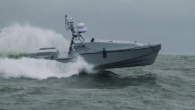
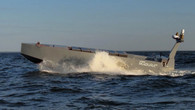
Four naval drones made by Latvian company NEWT21 joined Latvia’s Independence Day parade in Riga on 18 November, the first time such vessels have taken part. Two were FOG uncrewed surface vessels for reconnaissance, interception and strike, and two were RAY multipurpose catamarans carrying an interceptor drone and a remotely operated underwater vehicle. FOG has a carbon and aramid composite hull and a 90-horsepower waterjet, and NEWT21 claims 86 km/h, a 200-kilogram payload and 900 kilometres of range. The 5.4-metre RAY carries up to 500 kilograms at 78 km/h over 700 kilometres, and can serve in logistics, casualty evacuation, mine countermeasures and air defence. Both were tested in Ukraine before serial production began in August. Board chairman Jānis Garisons, a former state secretary at Latvia’s Defence Ministry, said they expand Latvia’s autonomous capabilities in the Baltic Sea.
Featured Image – A Chinese Telefly JT80 turbojet recovered from a Russian Geran-3 jet drone. China’s new export licences cover drone turbojets of 400 newtons or more, but only those specially designed for unmanned aircraft. Photo: Defence Intelligence of Ukraine (HUR)