Royal Navy Commissions Its First Autonomous Squadron
The UK Royal Navy has commissioned 1st Autonomous Squadron, with 180 sailors and marines running 55-knot crewless boats. Talon Blue heads to sea, Shield AI buys Echodyne, Valkyrie CCA’s price, American chips in a Geran and a mesh hunter.
A Squadron Without Crews
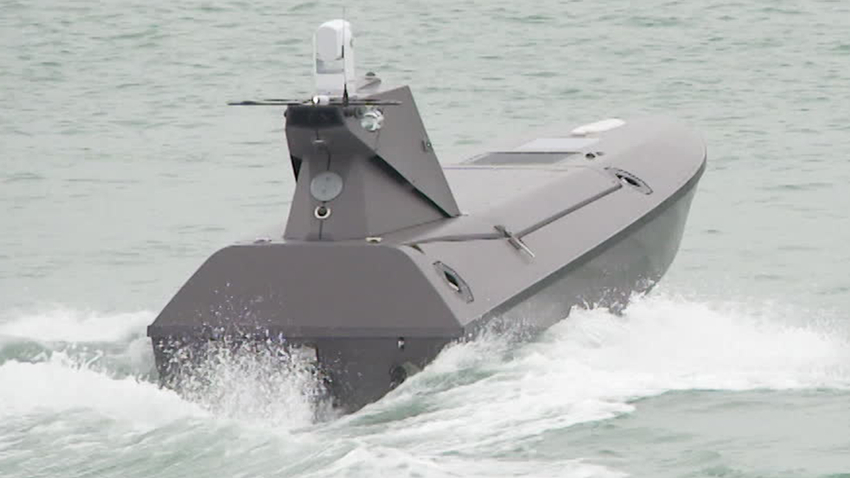
The Royal Navy has commissioned 1st Autonomous Squadron in Portsmouth, with some 180 sailors and Royal Marines to operate uncrewed boats on frontline operations rather than in experiments. Its main vessel is the Kraken K3 Scout: 8.5 metres long and 2.5 tonnes, with a top speed of 55 knots, a range of around 650 miles that can be stretched to 1,100, up to 30 days’ endurance and a modular payload of up to 400 kilograms for radar, strike or electronic warfare. The Rattler, a driverless rigid inflatable boat, will be used for training. Fleet Commander Vice Admiral Steve Moorhouse said autonomy would need more people and more money, not less, and compared the shift to the move from sail to steam. The squadron takes the navy beyond Project Beehive, its initial programme to buy crewless boats, and into operations.
Moving Too Fast?
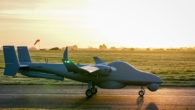
The Royal Navy also plans to launch Northrop Grumman’s YFQ-48A Talon Blue from a Queen Elizabeth-class carrier in 2027, First Sea Lord General Sir Gwyn Jenkins told the International Sea Power Conference aboard HMS Prince of Wales in Oslo. He intends to sign a statement of intent with Northrop on 12 November to prepare the jet-powered, autonomous drone for trials in UK waters under Project Vanquish. The aim is evidence for a hybrid air wing alongside the F-35B, not an immediate purchase. Recovery is the hard part. The carriers have a ski jump but no catapults or arresting wires, and it is unclear whether the trial will include a landing on board. Jenkins also rejected claims that the hybrid navy is moving too fast, saying the only risk he cares about is not being ready for war. Against an opponent that had adopted the technology when Britain had not, he said, “we will lose”.
Shield AI Buys Its Sensors
Shield AI is acquiring counter-drone radar maker Echodyne in a $5.3 billion deal, due to close in early 2027. Echodyne’s metamaterials electronically scanned array (MESA) radars are used in more than 40 countries, and in September Joint Interagency Task Force 401 picked them to supply counter-drone systems to US forces. Some $4.8 billion is payable at closing, with $500 million more if performance targets are met. Shield also raised $2.5 billion in Series H funding, with investment from Blackstone and JPMorgan Chase. The logic, both chief executives argue, is that autonomous systems can only act on what they sense. No aircraft integrations have been announced, and Shield says the deal does not affect its choice of an RTX radar for X-BAT. It is Shield’s latest purchase, after Martin UAV in 2021 and simulation firm Aechelon this year.
The Price Of A Valkyrie CCA
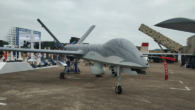
Kratos’ Valkyrie now costs about $6 million to $8 million per airframe, chief executive Eric DeMarco told investors, depending on configuration and before mission systems are fitted. That is above the $4 million to $6 million Kratos quoted for rocket-launched versions in 2024, and far from its old $2 million goal, but still at the low end for Collaborative Combat Aircraft (CCA). The US Air Force targets an average of $20 million for its first-increment CCAs, and Australia aimed for its Ghost Bat to cost a tenth of an F-35. DeMarco says Kratos builds 150 to 200 jet drones a year and that nobody can match its costs. The Marines are buying a runway-capable MQ-58B, and Airbus flew its European U740 variant in October. A Valkyrie crashed at Dugway Proving Ground in August, which did not come up on the call.
American Chips In A Geran
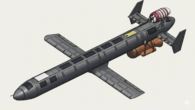
Ukraine’s Military Intelligence Directorate (HUR) has published a teardown of the Geran-5 K5-K, a smaller, faster variant that Russia began using against Ukrainian cities in early autumn. HUR says it now qualifies as a small cruise missile. It is 4 metres long against 6.5 for the standard Geran-5, cruises at more than 450 km/h, can reach 1,000 km/h in some manoeuvres and flies up to 6 kilometres high, with a 1,000-kilometre range and a 90-kilogram warhead. The examined drone carried a thermobaric warhead and the Susanin optical correlation navigation unit, which runs on a Chinese equivalent of the Raspberry Pi. Its TRD-200 turbojet is assembled at Alabuga from Chinese components. Of 93 electronic components, 52 came from US manufacturers, with China and Switzerland supplying 10 each, including Texas Instruments processors and Murata inertial modules.
Listening For The Mesh
Ukrainian firm Infozahyst says its Pluton passive detection system can now pick up the mesh modems in Gerbera, Molniya and Geran drones, listening on the main known frequencies of 1.5 GHz and 3.4 GHz at distances of up to 70 kilometres. Mesh networking lets each drone act as both receiver and relay, extending control range and letting operators steer almost to impact. It also makes jamming harder, because the network reroutes around lost nodes. Pluton already identifies first-person-view (FPV) drones as well as Supercam, Zala, Lancet and Orlan drones across 500 to 6,000 MHz, extendable to 24 GHz, and estimates when each will reach the protected site. Operators can now monitor and partly control any number of Pluton units remotely over a VPN. Digital FPV video detection is due in the next update.
Featured Image – The Kraken K3 Scout, the main uncrewed vessel the new RN’s 1st Autonomous Squadron will operate – BFBS